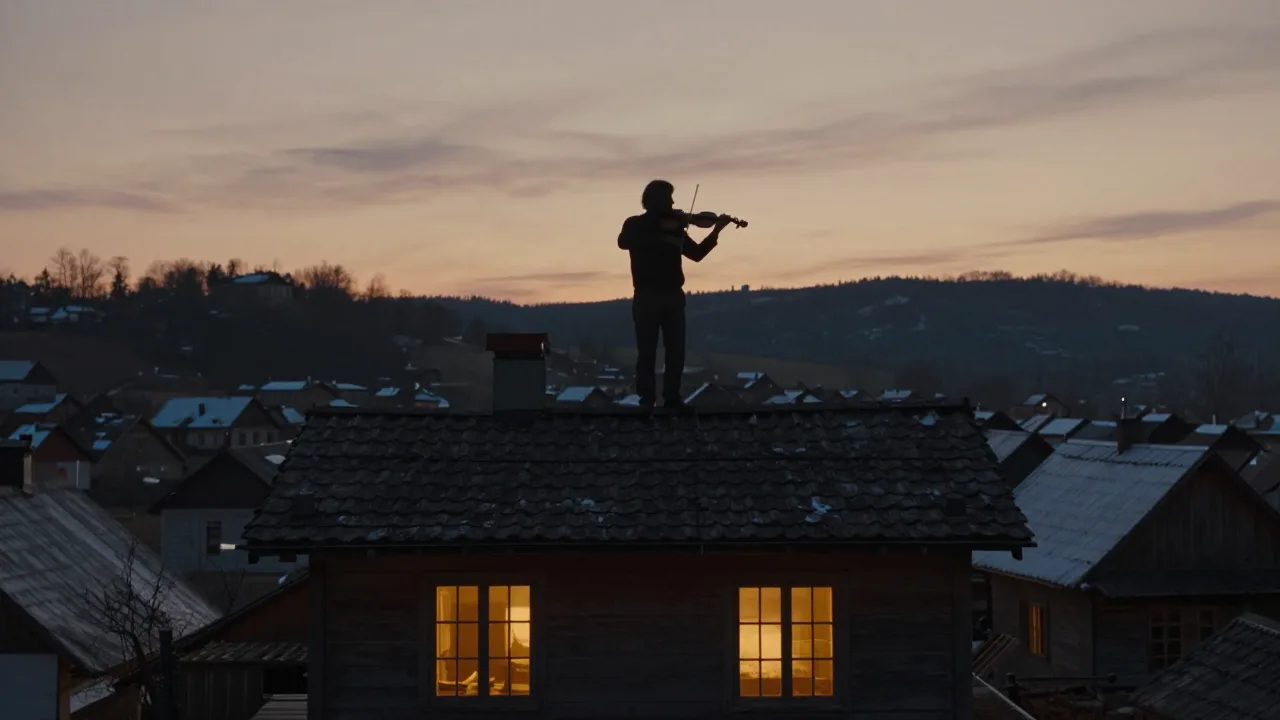
What is Fiddler on the Roof about?
Fiddler on the Roof is a landmark musical about Tevye, a poor Jewish milkman raising five daughters in the fictional village of Anatevka in Imperial Russia around 1905. Tevye tries to hold his household together through faith, humor and tradition while his daughters seek more control over whom they marry. The musical asks whether old customs can survive when family, love and politics make change unavoidable. Its mix of warmth and hardship is why it remains a frequent search topic, much like other stories built around family conflicts in The Family Stone or families under social pressure.
The show is based on stories by Sholem Aleichem, particularly those centered on Tevye the Dairyman. Joseph Stein wrote the book, Jerry Bock composed the music and Sheldon Harnick wrote the lyrics. It opened on Broadway in 1964 and became one of the defining American musicals of its era. At its center is Tevye, a man who talks directly to God, argues with himself and finds jokes even when life offers few easy answers.
The plot, without overcomplicating it
Tevye begins with a clear idea of how life should work. A matchmaker helps arrange marriages, parents guide their children and the village follows long-held religious and social customs. His eldest daughter, Tzeitel, wants to marry her childhood sweetheart rather than the wealthy man selected for her. Tevye eventually agrees. His next daughters make choices that challenge him further, each moving farther from the marriage rules he understands.
The personal story unfolds against rising antisemitism and political instability. Anatevka is not simply a nostalgic village setting. It is a community whose security can be taken away by official force. That contrast gives the final stretch of the musical its emotional power: the family arguments matter deeply, but they happen inside a larger world that is becoming more dangerous.
The songs people remember
The score contains standards that work both inside the plot and on their own. Tradition introduces the village order. Matchmaker captures the hopes and anxieties attached to marriage. If I Were a Rich Man lets Tevye dream aloud, while Sunrise, Sunset marks the speed at which children grow up. To Life is a communal celebration, and Do You Love Me? turns a practical marriage into a surprisingly tender conversation.
These songs endure because they move the story forward rather than pausing it. That is also why people still search for the meaning behind memorable song lyrics and the long cultural life of songs associated with Black Sabbath. A strong musical number gives audiences a feeling, then reveals something a spoken scene might not.
The 1971 film and stage productions
The best-known screen version is the 1971 film directed by Norman Jewison, with Topol as Tevye. It is known for its expansive outdoor imagery, detailed village setting and performances that preserve the musical's bittersweet tone. The film won three Academy Awards and remains a useful entry point for viewers who have not seen a stage production.
Stage versions remain common because the show can work at many scales, from major revivals to local theater. The cast, staging and language choices can differ, so it is worth checking a production cast before booking tickets. Dance also carries much of the story, especially during wedding scenes, which explains why viewers interested in Dancing with the Stars choreography may notice how movement communicates status, joy and community here.
Its longevity is not just a matter of nostalgia. Like a stage tour that becomes a cultural event, each revival invites a new audience to consider which traditions they keep, revise or leave behind. The most effective productions do not present Tevye as a villain for struggling with change. They show a loving father trying to understand a future he did not choose.
Where can you watch Fiddler on the Roof?
Streaming and rental availability changes by country and service, so check your local digital movie stores, subscription platforms, public library catalogue and nearby cinemas. Search specifically for the 1971 film if that is the version you want. This is the same practical approach used when looking up where to watch a particular film online. For a live production, look at the official venue listing, confirm the dates and read the accessibility information before buying.
Do not assume a title is available everywhere just because it appears in a search result. Regional rights, subtitles and rental options can differ. If you are choosing between the film and theater, the film offers a fixed, cinematic interpretation, while a live performance offers the immediacy of a changing cast and audience.
Why it continues to connect
Fiddler on the Roof lasts because it treats tradition as something people live inside, not merely something they quote. It respects the comfort of inherited rituals while showing their limits when real people need room to choose. That balance helps explain its appeal to viewers who also seek a cast guide for a beloved ensemble movie or reviews of a sequel shaped by audience memory.
For toughestblogger readers, the simplest answer is this: it is a musical with unforgettable songs, but its real subject is the cost of holding a family together when the world changes. Anyone inspired to explore musical-theater accompaniment can look into Pianoforall piano lessons for learning musical-theater accompaniment at home. A viewing night can also become a family meal, with The Complete Plant-Based Recipe Cookbook for planning a meat-free family dinner as a separate practical resource.
People also ask
What is the main message of Fiddler on the Roof?
The musical explores the tension between tradition and change. It follows a father who loves his family but struggles as his daughters make choices outside the customs he knows.
Is Fiddler on the Roof based on a true story?
It is based on fictional Tevye stories by Sholem Aleichem, but its setting reflects real Jewish life and antisemitic persecution in the Russian Empire.
What is the most famous song from Fiddler on the Roof?
If I Were a Rich Man is probably the most widely recognized song, although Tradition, Matchmaker, Sunrise, Sunset and Do You Love Me? are also major standards.