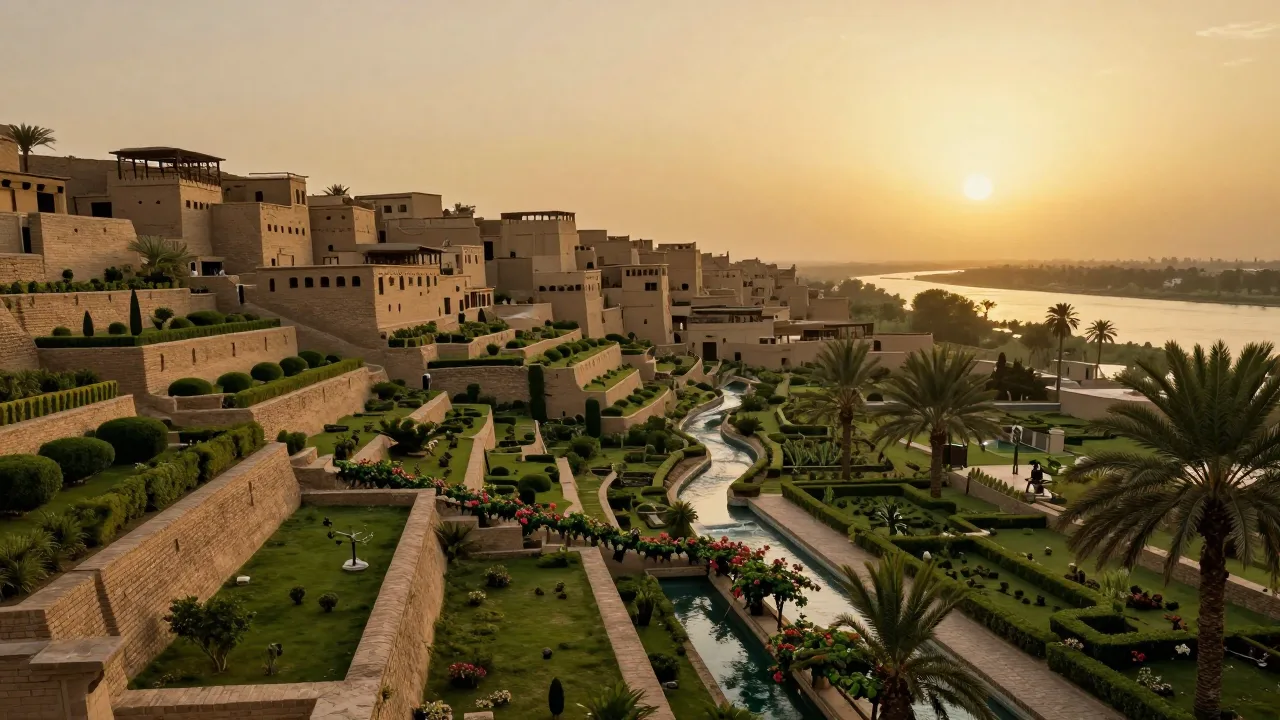
Did the Hanging Gardens of Babylon really exist?
The Hanging Gardens of Babylon were one of the Seven Wonders of the Ancient World, yet they are also the most elusive. Ancient Greek and Roman writers described terraces thick with trees, flowers and flowing water, built high above the city of Babylon in present-day Iraq. Archaeologists have not found a structure that can be confirmed as the gardens. The honest answer is that the gardens may have existed, but their location, appearance and even their city remain disputed. That uncertainty is part of their pull. A Medicinal Garden Kit for planning a useful home herb garden shows how much care even a small planted space needs. Keeping a large elevated garden alive in a hot ancient city would have required remarkable planning.
The word hanging probably did not mean plants dangling from the sky. It may have described trees and vines spilling over raised terraces. Modern readers imagining a green skyscraper are not entirely wrong, but the real inspiration was more likely a stepped palace garden. Anyone drawn to the practical side of growing food can compare that ambition with a Self-Sufficient Backyard plan for growing food and herbs at home, scaled for ordinary space rather than an ancient royal court.
Why is the evidence so uncertain?
No surviving Babylonian inscription plainly says, Here are the Hanging Gardens. The best-known descriptions come from writers who lived long after the Neo-Babylonian period. Berossus, a Babylonian priest writing in Greek during the third century BCE, is often cited through later authors. Diodorus Siculus, Strabo and Quintus Curtius Rufus gave versions of the story, but their measurements and details do not fully agree.
That does not prove the gardens were invented. Buildings vanish, cities are rebuilt and mud-brick structures leave difficult traces. Still, historians separate a famous tradition from a verified excavation. This is the same caution used when interpreting objects in a natural-science museum collection, where a label reflects evidence rather than wishful thinking. For a simpler starting point on ancient societies, a Britannica Kids learning guide can help place Babylon among the great cities of the old world.
| Question | Most careful answer |
|---|---|
| Did the gardens exist? | Possible, but unconfirmed. |
| Were they in Babylon? | Ancient tradition says yes, while some scholars argue for Nineveh. |
| Who built them? | Nebuchadnezzar II is the traditional attribution. |
| What did they look like? | Probably terraced and irrigated, not literally suspended. |
Who supposedly built the gardens, and for whom?
Most retellings credit Nebuchadnezzar II, king of Babylon from 605 to 562 BCE. He rebuilt Babylon on a grand scale, with massive walls, temples and palaces. A later romantic story says he made the gardens for his wife Amytis, who missed the green hills of her homeland. It is memorable, but historians cannot treat that love-story detail as settled fact because contemporary Babylonian records do not confirm it.
Another theory moves the wonder north to Nineveh, near modern Mosul. Assyrian king Sennacherib built a palace complex there and left inscriptions describing waterworks and gardens. Reliefs from Nineveh also show landscaped terraces. Supporters of the theory think later writers may have mixed up Babylon and Assyria. Critics say the case remains incomplete. Ancient irrigation was never decorative alone. Water supported crops and city life, much as cultivation still shapes farming communities such as Lundberg Family Farms.
How could an elevated garden have been watered?
If a royal terrace garden stood above ground level, its builders needed a constant water supply from the Euphrates or a canal. Ancient accounts mention channels, reservoirs and lifting devices. Historians have proposed chain pumps, buckets on wheels or other mechanical systems. The famous Archimedean screw is often mentioned in popular accounts, although tying that exact device to Babylon remains uncertain.
The engineering point is simple: a garden on high terraces lives or dies by its water system. Brick vaults may have supported deep soil beds, while bitumen could have helped resist leaks. A modern enclosed planting project faces a gentler version of that challenge when creating a catio with safe outdoor planting space. Even a backyard structure needs drainage, shade and strong materials. Those planning a more substantial garden feature might look at outdoor shed and bar structure ideas or TedsWoodworking garden pergola and raised-bed plans before adding weight, soil and water to a deck.
Why do the Hanging Gardens still matter?
The gardens endure because they combine two irresistible ideas: lost luxury and a technical puzzle. They also show that gardens have long been signs of power, comfort and imagination. A royal terrace planted with imported trees would have made a statement to every visitor below. That visual layering still appeals today, whether it appears in a 3D rug with layered visual depth or in a small balcony filled with climbing plants.
For toughestblogger readers, the useful takeaway is not to repeat every dramatic version as fact. Remember the core story: ancient writers described a spectacular irrigated garden, archaeology has not settled the question, and Nineveh is a serious alternative location. The legend also survives in lighter garden culture, from a garden gnome game to the fantasy of a sprite garden. If you want a real-world version of the same pleasure, look at how seasonal planting changes the Washington DC cherry trees, then start with one well-watered container.
People also ask
Where were the Hanging Gardens of Babylon?
Ancient writers placed them in Babylon, near modern Hillah in Iraq. Some modern scholars argue that the gardens may instead have been at Nineveh, an Assyrian city farther north.
Did archaeologists find the Hanging Gardens of Babylon?
No archaeological discovery has been accepted as definitive proof of the gardens. Excavations have revealed much of ancient Babylon, but not a structure everyone agrees matches the famous descriptions.
Who built the Hanging Gardens of Babylon?
Nebuchadnezzar II is the traditional builder in later accounts. The claim that he built them for Queen Amytis is widely repeated, but it is not confirmed by surviving contemporary Babylonian records.