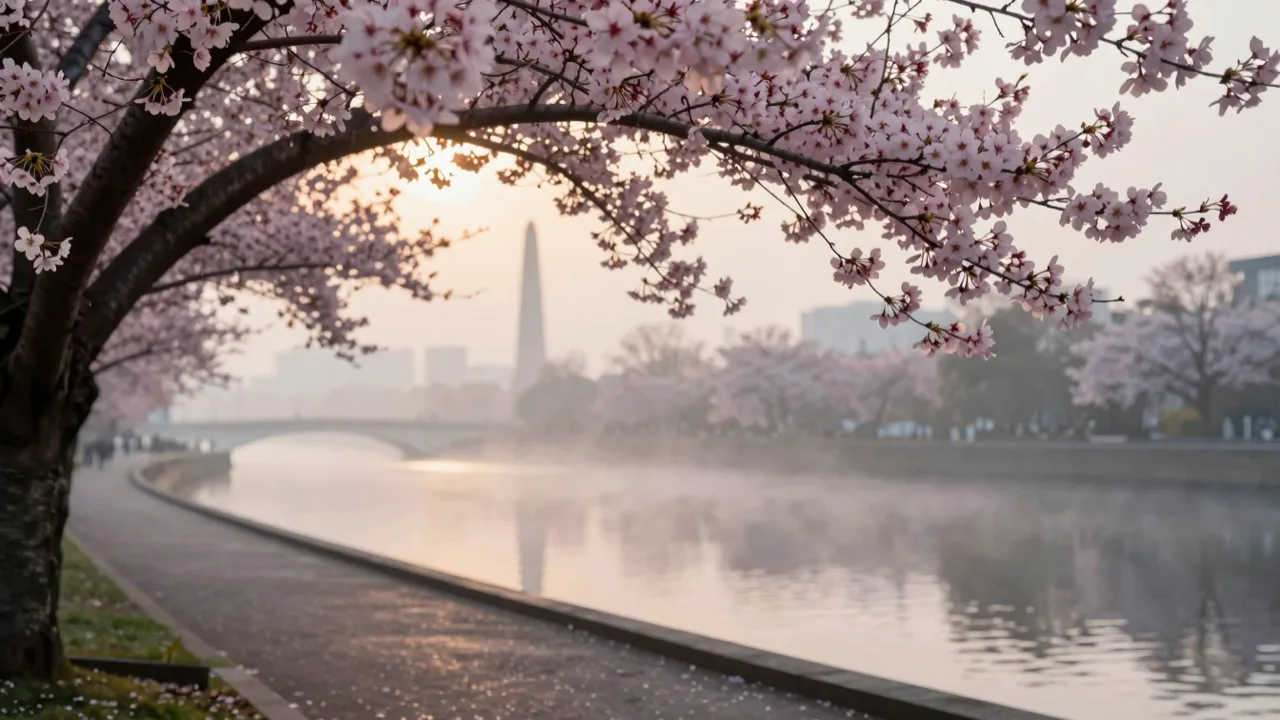
Washington DC cherry trees: the honest state of play
Most people type this search in March. The ones typing it in September want something narrower: are the trees still standing after the construction work, how many were taken out, and when to book for the next bloom. The collection around the Tidal Basin and East Potomac Park still runs to several thousand trees, and it remains free to walk among them, with no ticket and no timed entry. What changed is the shoreline. The National Park Service is rebuilding a seawall that had been letting water wash over the footpath at high tide, and a limited number of trees growing directly on that wall had to be removed so crews could work. The agency has said replanting will follow and will add more trees than were lost. If you are mapping out which months of the year of the horse are worth travelling for, treat this as a temporary fence rather than a permanent loss, much like the park and ride shuttle systems that reroute visitors around a closed entrance.
How many trees, and which kinds you are looking at
The original gift from Tokyo in 1912 was just over three thousand trees, planted along the Tidal Basin by the First Lady of the day. The living collection now numbers in the low thousands, spread across the Tidal Basin, the Washington Monument grounds and Hains Point in East Potomac Park. The great majority are Yoshino cherries, the pale, almost white ones that create the famous cloud effect. Behind them sit Kwanzan cherries, deep pink and heavily doubled, which open roughly two weeks later, plus smaller groups of weeping, Akebono and Okame types. The same logic applies as in any visitor guide that tells you which section peaks when: this is not one event but a rolling sequence, closer to a garden planted in layers rather than all at once.
The ones that can flower in autumn
Autumn flowering Higan cherries, scattered through the same parks, sometimes push out a light scatter of blossom in October or November, or during an unusually mild winter stretch. It is never the spring display and it is not predictable, but it is real, and it explains the out of season blossom photos that circulate. Watching the local forecast the way readers follow a trusted regional weather service instead of a national app is the only way to catch it. One practical note: this search often surfaces news about wildfire conditions in Washington State, which is a different Washington, three thousand miles away.
When peak bloom happens and how the forecast works
Peak bloom has a technical definition: the day roughly seventy percent of the Yoshino blossoms are open. Across recent decades it has landed in the final days of March more often than in April, though individual years swing by up to two weeks either way depending on late winter temperatures. The Park Service usually publishes its prediction in late February or the first days of March, then tracks the buds through a series of named stages so you can follow progress rather than guess. The display typically holds for several days and can be cut short by heavy rain or wind. Book refundable rooms, keep two weekends in play, and treat arrival like a festival weekend where crowd size dictates your entire schedule. Headphones loaded with a calming audio track that helps you settle into a long early morning walk make the pre dawn start considerably easier.
Where to see them beyond the Tidal Basin
The Tidal Basin is the postcard, and by nine in the morning at peak it is shoulder to shoulder. Hains Point, at the tip of East Potomac Park, holds hundreds of trees with a fraction of the crowd and water on both sides. The Kenwood neighbourhood in nearby Bethesda, Maryland, is a residential grid famous for its canopy, best reached without a car. The National Arboretum and the gardens of Dumbarton Oaks in Georgetown offer quieter, more curated versions. Waterside walking here rewards attention to the tide much as a table at an oceanfront dining room where the water comes right up to the glass does. If you want a second reason to be in town, the calendar around the capital tennis tournament held later in the year is a far quieter hotel season.
Cost, transport and the timing that works
There is no entry fee. Your costs are transport, food and a bed. Driving is the worst option: parking near the Tidal Basin at peak is close to nonexistent and the riverside road fills before sunrise. Take the Metro to the Smithsonian station and walk. Arrive before seven if you want photographs without a hundred strangers in them, which makes an independent coffee house that opens genuinely early more useful than the hotel breakfast. Meals are worth planning: readers of toughestblogger who have used the fixed price restaurant week menus that make the capital affordable know the city is not cheap otherwise. Crowd behaviour resembles a city cultural festival with a fixed footprint and no way to expand it: come early, or come midweek.
What to bring, and what first timers get wrong
Bring layers, because late March mornings by the water are cold, and bring your own food, because vendor queues are long. Pastries travel well, whether that is a bulk box of small chocolate filled pastries or something you baked, and out of season the same walk pairs nicely with the pumpkin and cream cheese muffins that suit an autumn park visit. The biggest mistake is treating peak bloom as a fixed date and booking non refundable months ahead. The second is climbing on or pulling at branches, which damages trees already under stress. If the trip leaves you wanting your own corner of blossom, a plan library for building a garden bench or planter box yourself is a cheaper souvenir than anything sold at the Basin.
People also ask
Are the Washington DC cherry trees still there after the construction work?
Yes. The large majority of the collection is untouched. A limited number of trees growing directly on the failing Tidal Basin seawall were removed so the wall could be rebuilt, and the National Park Service has said replanting will add more trees than were taken out.
When do the cherry trees in Washington DC bloom?
Peak bloom, defined as about seventy percent of the Yoshino blossoms being open, has most often fallen in the last days of March in recent decades, with a swing of roughly two weeks either way. The official forecast is normally published in late February or early March.
Do you have to pay to see the cherry blossoms?
No. Walking the Tidal Basin and East Potomac Park is free with no ticket or timed entry. You only pay for transport, food, parking if you insist on driving, and optional extras such as boat rentals or ticketed festival events.
Where can you see the trees without the crowds?
Hains Point at the end of East Potomac Park, the Kenwood neighbourhood in Bethesda, the National Arboretum and Dumbarton Oaks are all far quieter than the Tidal Basin. Arriving before seven in the morning also thins the crowd dramatically.
Can cherry trees in DC bloom in autumn?
Some can. Autumn flowering Higan cherries occasionally produce scattered blossom in October or November, or during a mild winter spell. It is sporadic and unpredictable, and it never matches the spring display.
